
Slouching won't suffocate you. But the research shows it makes every breath smaller and harder, and the fix takes less than a minute.
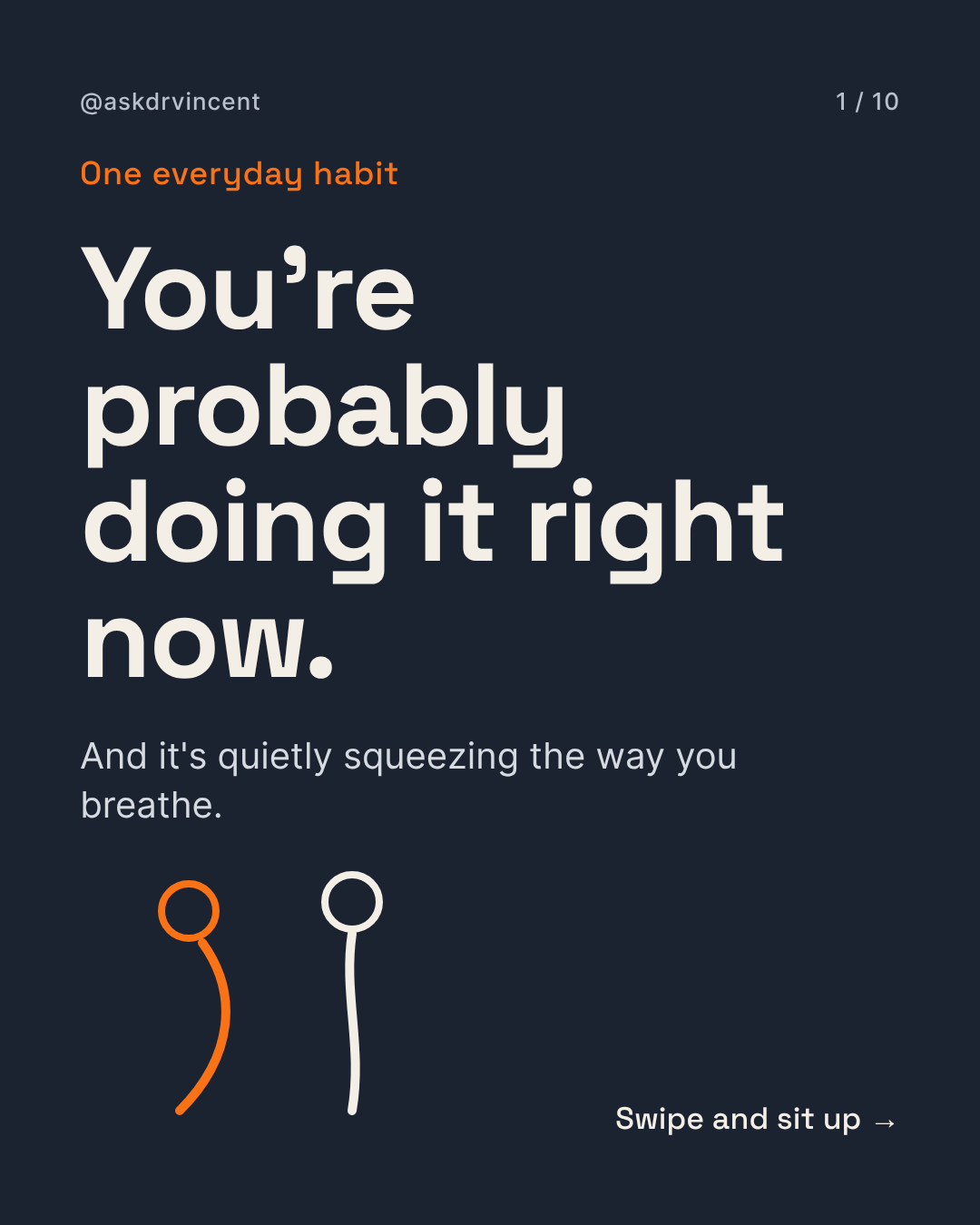
Next time you're in a café, a waiting room or on a train, look around. Almost everyone is in the same shape: head forward, shoulders rolled in, chest folded down towards a phone.
I'm no exception. I spend a lot of my working day at a laptop, and I'll catch myself an hour into writing, curled over the keyboard like a question mark. As a scientist, I'm used to thinking about ageing in terms of what happens inside our cells: oxidative stress, inflammation, what we eat. It's easy to forget that something as basic as how we sit changes how our body works, all day long.
So I went looking at what the research actually says about posture and breathing. Here's what I found.
Why breathing needs room
Your main breathing muscle is the diaphragm, a dome of muscle sitting under your lungs. When you breathe in, it contracts and drops, and your ribcage lifts and widens. That creates space, and air rushes in to fill it.
The key word is space. When you slouch, you fold your upper body over your belly. Your diaphragm has less room to move down, and your lower ribs have less room to move out. You can feel this yourself right now: slump right over and take the deepest breath you can, then sit tall and do the same. Most people notice the difference straight away.
What the studies measured
Slumped sitting. In a study of 70 adults published in Archives of Physical Medicine and Rehabilitation, researchers measured lung capacity and how quickly people could breathe out in different postures. Slumped sitting reduced these measures compared with sitting normally, and standing produced the best results. Interestingly, sitting right back in the seat with good lower back support did better than ordinary sitting on several measures. (Lin et al., 2006)
Forward head posture. This is the "phone neck" position, where your head drifts out in front of your shoulders. A study in the Journal of Physical Therapy Science tested healthy adults sitting with their head forward versus neutral. In the forward position, forced vital capacity (the total air you can blow out after a full breath) and FEV1 (how much you blow out in the first second) were both significantly lower. The researchers also tracked markers on the chest and found the lower ribcage moved significantly less with each breath. (Koseki et al., 2019)
Breathing muscle strength. A third study, in BioMed Research International, measured inspiratory pressure, a marker of how strongly your diaphragm and breathing muscles can pull air in. In 15 healthy young men, average pressure dropped from 93.5 cmH₂O sitting upright to 80.8 in a forward head posture. That's about 14% lower, and the posture was only held briefly. (Zafar et al., 2018)
The honest bit
I want to be careful here, because posture content online gets exaggerated quickly.
These studies were small, mostly in young and healthy people, and they measured breathing capacity and breathing muscle strength. They did not measure the oxygen level in your blood. In a healthy person, slouching is not going to starve your body of oxygen or suffocate you.
What it does is make each breath a bit smaller and a bit harder work. Now multiply that by the hours most of us spend at desks, on couches, in cars and on phones. It's not an emergency. It's a slow, everyday drag, and that's exactly the kind of thing I think is worth fixing, especially when the fix is free.
My 3-2-1 reset
I use this a few times a day. It takes under a minute.
3 cues to stack yourself
Ears over shoulders.
Ribs over hips, not collapsed towards your belly.
Bottom right to the back of the chair, with your lower back supported.
2 slow breaths into your belly
Put a hand on your stomach and breathe in slowly through your nose. Let your belly rise before your chest does. That's your diaphragm doing its job with room to move.
1 stand-up, every 30 minutes or so
Standing gave the best lung measures in the first study. Set a reminder, refill your water, take a call on your feet.
Make the good position the easy one
Willpower doesn't last all day, so set up your space to do the work:
Screen: top of it at eye level. A stack of books works fine.
Phone: bring it up to your eyes rather than dropping your head to it.
Chair: sit right back so your lower back is supported.
Feet: flat on the floor, knees roughly level with your hips.
If you have ongoing back or neck pain, or you notice you're short of breath, don't just fix your chair. See your GP or a physiotherapist.
The bottom line
We spend so much energy on what to eat and which supplements to take. Some of the most useful things you can do for your body cost nothing at all. Sitting tall and breathing properly is one of them.
I've turned this into a carousel you can save and share. Find it on Instagram at @askdrvincent.
Dr Vincent
Discussion about this post